How Are French Art Deco Straw Marquetry Boxes Made
Materials by Alexander Lamont
Within a leafy compound on the outskirts of Bangkok, backside a pair of old iron gates, lie the workshops and studio of Alexander Lamont. In this single location Alexander Lamont has brought together a rarefied and all but extinct group of decorative materials and arts and crafts skills that through his contemporary design sensibility, combine to make the pieces in his collections.
The workshops business firm ateliers for shagreen, straw marquetry, parchment, natural lacquer, gesso, gilt leaf and statuary. Alexander Lamont brought world experts over from Europe to train his teams of artisans in these materials. He also travels to Mainland china regularly to work closely with Peking Glass kilns and pocket-sized rock crystal producers to create his unique designs using these materials.
For Alexander Lamont, the exploration and innovation of materials is a powerful strength that drives the creative direction of his company. To take something rare and beautiful that has been used for centuries, to push it a little fleck farther, and to bring it into the present are the challenges that Alexander Lamont seeks and thrives upon.

Statuary
One of the start craftsmen that Alex worked with in Thailand was a statuary caster from Chiangmai, a master of the lost wax method traditionally used for Buddha sculptures: a model is made in wax then covered with clay, dried and heated. The wax melts and pours out or "is lost" through flues, leaving a cavity the same as the original wax. Together Alex and the bronze caster fabricated the first piece: a bronze bowl encrusted with the coils that cover the caput of the Buddha. Equally Alex recounts, "at that place was something monumental and primordial about the mass of statuary that flowed to make this vessel".
At Alexander Lamont we work in both statuary and brass depending on the item. They are different because of the relatively higher copper content in bronze. This makes bronze slightly softer and a tone darker than brass. However, brass is frequently preferred due to its forcefulness and the power to create thinner, lighter pieces.
As office of the finishing procedure, we apply various patinas to our brass/bronze products in order to attain the desired colour and finish. In 2013 the British bronze artist, Michael Talbot, came to our workshops to train our bronze patination artisans. He helped us with refining and improving the range of bronze finishes that nosotros apply to our statuary pieces of furniture, sculpture, lighting and accessories. Michael has also been working with us to develop new patination processes and finishes that are innovative in terms of design and difficult-wearing and durable in terms of quality.


Gesso
Traditionally a substrate applied to a base of operations material to achieve a shine surface for the application of paint or other materials, gesso or "Italian gesso" has been an of import fabric in traditional European arts.
Made by combining gypsum powder and hide glue, the gesso is applied hot in multiple layers and so sanded betwixt each layer to attain a perfectly smooth material base that supports various hand-applied finishes including water-gilding, natural lacquer and cracked wax polished surfaces.
At Alexander Lamont we utilize gesso to attain certain finishing effects upon which lacquer or paint or wax is then applied. Through various techniques we achieve innovative effects such as "craquelure" that resonate of antiquarian crackled tusk or smoldering embers.

Gilt Leaf
At Alexander Lamont we use pure gold and silver leaf for gilding. The gold is hammered by hand in Thailand. The leaves are then prepared on a vellum pad, cut past gilding knives and lifted by special brushes before being applied by hand onto a lacquer, shagreen or bronze surface. The translucency of precious metallic leaf means that to reach a shiny result, the surface must be perfectly polish and polished. Gold and silver leaf are extremely thin but volition last many years if non rubbed or touched excessively.
Gold tarnishes slightly over time while silver oxidizes faster. At Alexander Lamont we believe that tarnishing is a beautiful aspect of real gold and silver that does not occur on faux metals and that information technology should be regarded as part of the metal'southward ageing and natural patination process.

Lacquer
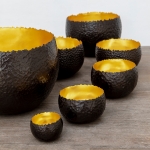
Liquid, dark, smokey, polished, lacquer is a monastic material demanding patience and deliberation. Lacquer is a natural fabric extracted from trees and seeds. Thailand has an ideal climate for natural lacquer equally humidity and oestrus is required for the curing process.
Our lacquer artisans received their training from Frenchman Eric Stocker, a main of natural lacquer and of the traditional methods used by the Paris-based designers Jean Dunand and Eileen Gray in the 1920'southward.
The presence of other rare craft skills in the one location has enabled our lacquer workshops to create unique finishes blending the materials of Europe and Asia for the get-go fourth dimension. The layering of panels of stingray skin with coats of cinnabar lacquer creates the signature "Opium Lacquer" and applying lacquer over layers of straw creates the sublime "Lacquered Straw" terminate.
Nosotros also make eggshell lacquer whereby small pieces of craven or duck trounce are cracked carefully using pins so that the pieces fit similar a jigsaw across the surface. The finished surface may then exist lacquered with a cashew lacquer to give a deep rouge tone and accentuate the blueprint.
Mica
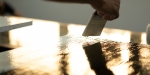
Neither a stone nor a resin, Mica belongs to a unique class of rock-forming minerals known equally silicates. Mica's diaphanous, translucent and intense lustre have fabricated it pop across a myriad of applications since antiquity. In tiny flakes, its utilize can exist traced back to pre-historic cave dwellings and ancient pottery from the Americas. Found raw in a natural layered texture, mica tin can be de-laminated into sparse sheets and its opacity ranges from transparent to opaque. It began to be used widely in this course by the Arts and Crafts and Art Nouveau Movements for lamp shades and lanterns. During the Art Deco period modernist designers introduced mica as a decorative fabric for piece of furniture as well as lighting.
Alexander Lamont has taken this fragile, glowing fabric and developed two signature finishes for vertical surfaces and walls. In our mica workshop our artisans carefully select sections of mica within the desired tonal palette, composing them slice past slice into emphasis walls that grab the light with a captivating iridescence, and bring an air of glamour and refinement.

Parchment
With a surface like sheets of soft ivory, parchment became pop as a decorative finish during the 1920's when modernism demanded neutral materials that maintained a sense of luxe. Advanced French designers such as Jean-Michel Frank, Jean Prouvé, and André Arbus rebelled against the bourgeoisie's taste for erstwhile tapestries and night wood, and designed clean-lined furniture upholstered in white kidskin and tables crafted of eggshell lacquer and parchment.
Parchment is a thin material fabricated from calfskin, sheepskin or goatskin. Historically its most common use was for the pages of books or manuscripts. Vellum is the name commonly used for a finer version of parchment, made from sheepskin or calfskin. Parchment or vellum is unlike leather in that information technology is not tanned, but stretched, scraped and dried nether tension, which yields a strong, translucent peel that requires great skill to dye and successfully apply to a wood substrate.
Alexander Lamont makes parchment furniture, lighting and objects. We have also developed printing methods that create layers of pattern over the surfaces such as the coral blueprint on the Ocean Armoire and our newest technique, 'Suji' is hand-dyed parchment that creates a shimmering linear effect on the surface of the Mighty Tabular array.


Peking Glass
The term 'Peking Drinking glass' refers to a item method of creating drinking glass adult by the imperial workshops in Peking during the Qing Dynasty.
A kiln is filled with raw glass 'frit' mixed with pigment. Molten glass is repeatedly 'gathered' from the kiln on a blowpipe until a heavy 'gob' is collected. The repeated gatherings requite rise to the unique rings on our glass forms. The glass must be 'annealed' (slowly cooled). The final shaping and polishing is done by hand in the old jade-cutting process of methodical grinding. This phase solitary takes from two to four days for every piece.
Alexander Lamont works with kilns in Peking to create modern forms of vases and lighting elements in burnt amber, royal yellowish and white-jade colours.


Rock Crystal
Translucent and opaque, clear and amber hued, lacey with globe-trotting inclusions, crystals create the most evocative natural lighting. Naked flames, seen through natural cystals, with all their intrinsic imperfections and flaws, have been used as lighting elements for centuries and are one of the bang-up materials for creating an atmosphere of old world elegance.
For our lighting collections, Alexander Lamont works with natural stone such as calcite and fluorite, rock crystal from Brazil, faux rock crystal, selenite and leaded crystal.


Shagreen
A texturally rich and visually intriguing material, shagreen or "galuchat" in French, shark and stingray skins were originally used by the Japanese to decorate armour and weaponry. Subsequently, Europeans used the stiff lustrous skin for precious boxes and scientific instruments. Nearly famously, during the Fine art Deco period, modernist decorators such as Jean Michel Frank and Clement Rousseau applied stingray skin to their furniture and lighting collections.
Using raw skins is a mysterious procedure that took our workshop almost ten years to perfect. Alexander Lamont and a small team of artisans originally received grooming in the fine art deco technique for using raw skins from the earth expert on shagreen, Jean Perfettini. A restoration expert at the Musee des Arts Decoratifs in Paris, Jean trained our shagreen workshop in the painstaking techniques for thinning, cleaning, dyeing, cutting, adhering and finishing the raw skins to achieve a surface that has been described as 'a one thousand thousand chaplet of ivory'.
We use only the traditional raw stingray skins in our work because the durability is greater, the cease more tactile and the myriad natural tones far more beautiful than those of pre-dyed chromium-tanned skins, which are more commonly found in use today. In addition, our method does not involve the unpleasant polluting procedure for which tanned skins are notorious. While honouring the traditional technique, we have establish our own ways to finish and utilize shagreen giving a new character to this rare material.


Harbinger Marquetry
Harbinger marquetry is the art of forming a decorative panel using flattened slithers of natural cured straw. The stalk is split, flattened, softened and scraped or ironed into a apartment ribbon. It is then inlaid edge to edge on paper or woods until the surface is covered. The procedure is entirely hand made and in our workshop we use but manus tools, and water-based adhesives and dyes. From the preparation of the straw into ribbons, to the dyeing process, to the choosing and inlaying of each single piece of harbinger onto the surface, the fine art of harbinger marquetry requires patience and a well-developed sense of colour and tone.
In 2011 Gerard Morin, an internationally known straw marquetry artist, came to help us improve our straw preparation technique, and to experiment with us in new colouring techniques. He trained our artisans in the history, traditional designs and traditional craft skills involved in straw marquetry. In addition to this he helped united states of america to strengthen our relationships with our suppliers of straw in France.
Alexander Lamont uses straw marquetry to make beautifully detailed cabinets, mirror frames, lamp bases, boxes as well as wall paneling. The special aspect of harbinger is that is has a surface that reflects light uniquely and subtly.


Source: https://www.alexanderlamont.com/en/trade/materials/
0 Response to "How Are French Art Deco Straw Marquetry Boxes Made"
Post a Comment